

Why Your Breath Test Result Is Not the Final Word
A high breath test result in a Harford County DUI case can feel like the end of the story, but it is not. A number printed from an Intoximeter EC/IR II is powerful evidence for the State, yet it must still be shown to be reliable, obtained correctly, and handled under proper procedures. Courts in Maryland see many DUI cases that rise or fall on this single piece of evidence, which can affect criminal charges, potential penalties, and what happens to your driver’s license.
What many people do not realize is that breath testing is technical, rule-driven, and highly dependent on both the machine and the officer using it. That is where a local Harford County DUI lawyer comes in. Someone who works regularly in Bel Air, Havre de Grace, and the nearby courts knows the specific machines, typical police practices, and local expectations of judges, and can spot problems that are easy for an untrained person to miss.
How Breathalyzers Work in Maryland DUI Cases
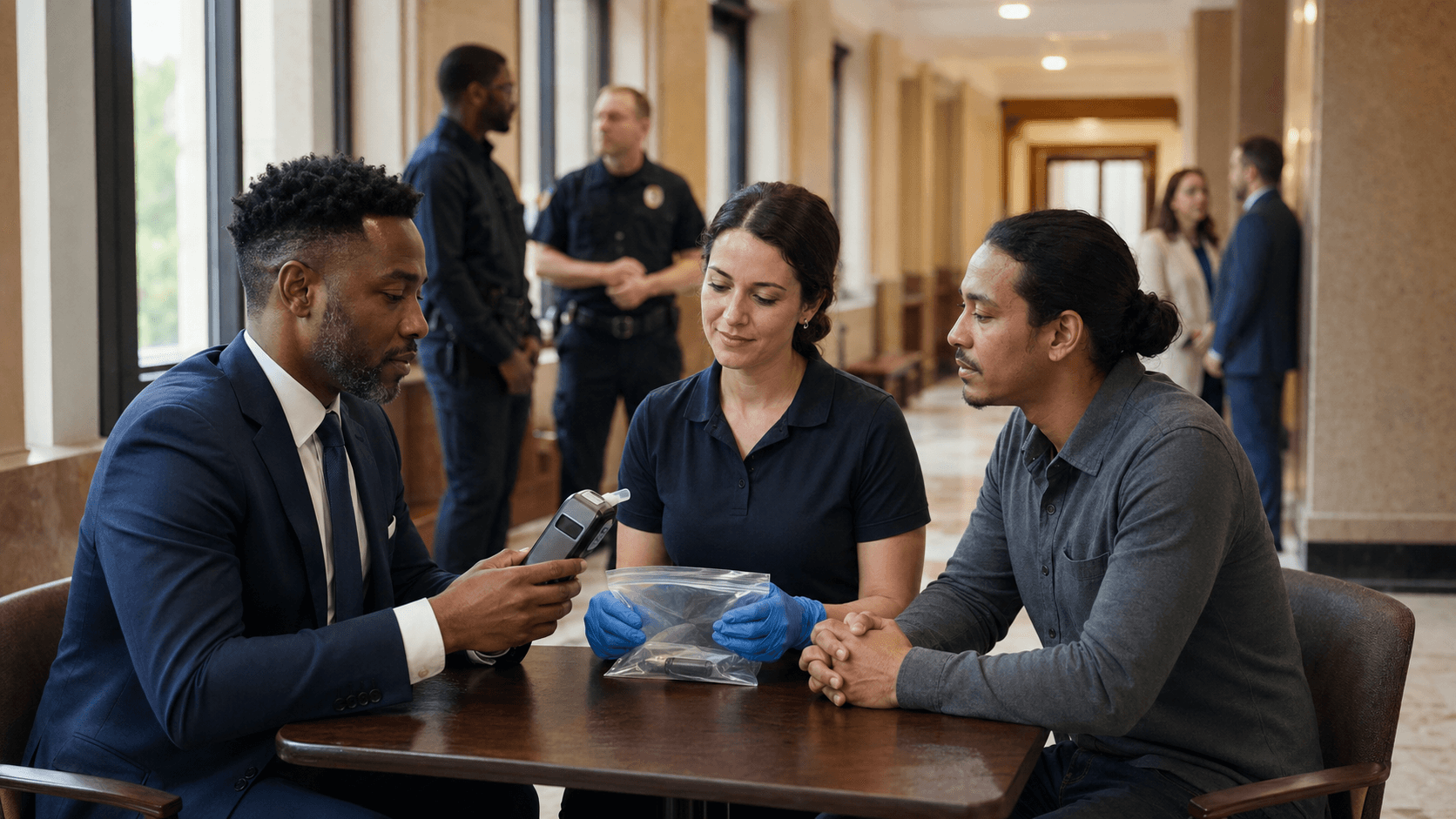
To understand how to challenge a breath test result, it helps to know the basics of how the Intoximeter EC/IR II works. This device uses two main technologies, electrochemical cells and infrared light, to analyze deep lung air that you blow into the mouthpiece. The machine then converts that information into a blood alcohol concentration, or BAC, that appears as a number on the printed ticket.
It is also important to distinguish between the small portable breath test, often used roadside, and the official test at the station. The handheld portable breath test, sometimes called a PBT, is generally used for investigation, not for the final evidentiary BAC number in court. The official test in Maryland DUI cases is usually the Intoximeter EC/IR II given at a police station or Maryland State Police barrack under the implied consent law, after you have been formally arrested.
For the State, it is not enough to say that a machine produced a reading. Prosecutors must show that the Intoximeter EC/IR II was working properly, that the operator followed required procedures, and that the result is considered scientifically reliable under Maryland law. If any of those links in the chain are weak, a judge can question or limit the use of the breath result.
The Intoximeter EC/IR II Used in Harford County
Harford County law enforcement agencies commonly use the Intoximeter EC/IR II as their official breath testing device. After a DUI arrest in places like Bel Air or Havre de Grace, drivers are often brought to a local police station, sheriff’s office, or Maryland State Police barrack where one of these machines is located. The test process is fairly standardized, but the details matter a great deal when the result is challenged later in court.
Maryland has rules for which devices are approved and who may operate them. Officers must be trained and certified to administer EC/IR II tests, and they are expected to follow specific testing protocols, such as a set observation period and proper documentation. Those rules exist to reduce errors, but in real cases, officers do not always follow them perfectly.
A seasoned Harford County DUI lawyer will be familiar with the printouts, data fields, and codes that appear on EC/IR II test tickets and logs. Local experience also means knowing how particular judges typically view these machines, which issues they take seriously, and where there is flexibility to argue about reliability.
Calibration, Maintenance, and Common Machine Problems
Even a sophisticated device like the Intoximeter EC/IR II is only as good as its calibration and maintenance. Calibration is the process of checking the machine against a known alcohol standard to confirm that the readings are within acceptable limits. Maryland requires periodic checks and quality control tests to keep the EC/IR II in service. If these checks are skipped, done late, or show inconsistent results, that can call a BAC reading into question.
Defense attorneys often examine the machine’s history for issues such as:
- Missing or incomplete calibration and maintenance entries
- Failed or questionable simulator solution tests
- Unexplained error codes or aborted tests
- Records showing the machine was later taken out of service
A Harford County DUI lawyer can request maintenance logs, certificates of accuracy, and quality control documents for the specific EC/IR II used in your case. By reviewing those records, we look for gaps or irregularities that suggest the device might not have been functioning properly at the time of your test.
Officer Errors That Can Undermine a Breath Test
Machine problems are only half the story. The officer operating the Intoximeter EC/IR II must also follow clear procedures that are designed to prevent contamination or skewed results. One of the most important is the observation period, often described as around 20 minutes, where the officer watches the driver to make sure there is no burping, vomiting, chewing, or foreign substance in the mouth that could cause mouth alcohol and artificially elevate the reading.
There are other steps officers are expected to take. Common problems a defense lawyer might look for include:
- Failing to properly observe the driver before the test
- Not checking the mouth for foreign substances or dental appliances
- Incorrect timing between breath samples or multiple attempts
- Having a non-certified or lapsed-certified operator run the test
The way officers explain refusal rights, implied consent, and the consequences of taking or refusing the test can also be important. A Harford County DUI lawyer can review body-worn camera footage, written reports, DUI citations, the DR-15 advice of rights form, and the EC/IR II test ticket to uncover deviations from required Maryland State Police protocols.
Legal Strategies to Challenge Breathalyzer Results in Court
All of this technical material comes together in court through legal strategy. One approach is to file motions to suppress the breath test if the initial traffic stop or arrest lacked legal grounds, or if the implied consent warnings were confusing or incorrect. If the stop or arrest is found unconstitutional, the breath result might be excluded entirely.
Attorneys may also file motions aimed directly at the breath result itself, arguing that it should be kept out because the State cannot prove its scientific reliability. Cross-examining the arresting officer, and sometimes a breath test coordinator or similar witness, allows us to probe training, familiarity with the Intoximeter EC/IR II, and adherence to testing protocols.
In some cases, we may use expert witnesses or technical documentation to explain issues like margin of error, potential mouth alcohol, certain medical conditions, or known limitations of the specific instrument used. The goal is to show the judge that the breath result is not nearly as simple or unassailable as a single number might appear.
Protecting Your Rights After a DUI Arrest in Harford County
What you do right after a DUI arrest can affect how strong your defense will be later. It is important to keep every piece of paperwork you are given, including citations, the DR-15 form, and any temporary license document. You should also be aware of strict deadlines to request an MVA hearing if you want to challenge an administrative license suspension that can come from a high breath result or a refusal.
Just as important, you should avoid discussing the details of your case with anyone other than your attorney. Conversations with friends, family, or on social media can be misunderstood or used against you. A local Harford County DUI lawyer can move quickly to preserve evidence, request EC/IR II records, review video, and begin building a defense that focuses on both the machine and the procedures used in your case.
A breath test result is evidence, not destiny. With careful attention to the Intoximeter EC/IR II’s calibration history, maintenance records, and printouts, combined with a close review of officer conduct and Maryland testing rules, it is often possible to challenge or limit the impact of that number in court.
Protect Your Future With Experienced DUI Defense
If you are facing a DUI charge in Harford County, you do not have to navigate the legal system alone. Speak with an experienced Harford County DUI lawyer at Harford County DUI so we can review your situation and explain your options clearly. We will walk you through each step of the process, answer your questions, and build a strategy tailored to your case. To schedule a consultation, simply contact us today.